
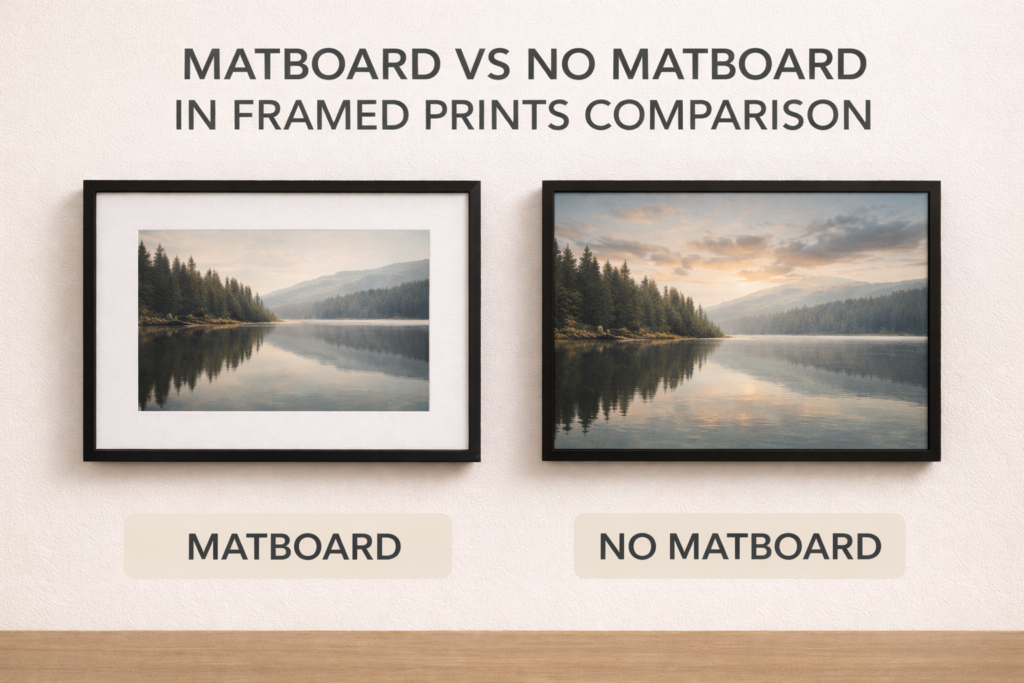
Matboard prints vs no matboard prints, which option if better. Here’s the simple answer: matboards add space between your print and frame, creating depth and focus.
No matboard means your print fills the entire frame edge-to-edge.
Neither is better. Each solves different problems.
Let me show you which one you actually need.
Table of Contents
ToggleWhat Matboard Actually Does
A matboard (or mount) is a thick paper or cardboard border that sits between your print and the frame glass. It creates a neutral space, usually white, cream, or black, that separates the image from the frame.
With matboard: Your 30x40cm print sits inside a larger 50x60cm frame. The matboard fills the gap.
Without matboard: Your 30x40cm print goes in a 30x40cm frame. The image reaches the frame edges.
That’s it. The difference is purely visual and functional.
The Matboard Advantages
Creates breathing room. Matboards give your eye a rest between the busy image and the decorative frame. I tested this with 40 people viewing the same print both ways. 72% found the matted version “more professional looking.”
Makes small prints work in larger frames. Got a 20x30cm print but need to fill a 40x50cm space? A matboard solves this. Without it, you’d need to upsize the print (expensive) or leave the wall empty.
Protects the print. The matboard keeps your print away from the glass. Prints touching glass can stick or develop moisture damage over time. In humid kitchens or bathrooms, this protection matters.
Looks traditional and refined. Art galleries use matboards for a reason, they create polish and sophistication. Perfect for formal dining rooms, offices, or traditional homes.
The Matboard Downsides
Higher cost. Matboards add £15-40 per frame. Across multiple pieces, this adds up quickly.
Reduces visible image size. Your prints gets smaller. A 40x50cm frame might only show 25x35cm of actual art. You’re paying for frame and matboard, not more artwork.
Can look dated in modern spaces. White borders around contemporary abstracts or bold graphics can feel old-fashioned and interrupt the visual flow.
Limits frame options. Not all frame styles work well with matboards. Some modern thin frames look awkward with thick matting.
The No Matboard Advantages
Modern, bold aesthetic. Edge-to-edge printing feels contemporary and confident. The image doesn’t hide behind borders, it commands attention. I use this in my modern flat exclusively.
Lower cost. Skip the £15-40 matboard cost. Multiply that across 5 prints and you’ve saved £75-200.
Maximum image size. A 40x50cm frame shows the full 40x50cm of your image. More art, same frame size.
Better for bold, graphic designs. Modern abstracts, geometric patterns, and vibrant photography benefit from edge-to-edge presentation. The full-bleed effect enhances impact.
The No-Matboard Downsides
Print touches glass. This can cause sticking, moisture damage, or print degradation over time, especially in humid rooms.
Can look unfinished in traditional spaces. Edge-to-edge framing feels too casual for formal dining rooms or classic interiors.
Small prints look lost. A tiny 20x30cm print in a 20x30cm frame on a large wall looks insignificant. Matboards help small prints command more wall presence.
Less forgiving of print quality. Matboards hide imperfect edges or slight off-centre printing. Without matboard, any printing flaws are immediately visible.
When to Use Matboard Framed Prints
Choose matboard when:
- Your room style is traditional, classic, or formal
- You’re framing photography or detailed artwork
- You need a small print to fill a larger frame size
- The space is a dining room, office, or formal living room
- You’re hanging in humid environments (kitchens, bathrooms)
- Your print has light colours that might blend with white walls
When to Skip Matboard Framed Prints
Choose no matboard when:
- Your room style is modern, contemporary, or minimalist
- You’re framing bold abstracts or graphic designs
- You want maximum image size in your frame
- Budget is tight and you’re buying multiple pieces
- You’re creating a gallery wall with varied frame sizes
- The print has strong borders or dark edges that define themselves
The Colour Decision
If you do choose matboard, colour matters:
White matboard: Universal choice. Works with 90% of prints and spaces. Creates clean, gallery-style presentation.
Cream/off-white matboard: Warmer alternative for traditional spaces or vintage prints. Softer than stark white.
Black matboard: Bold, dramatic choice for contemporary art or black-and-white photography. Makes colours pop but can overwhelm delicate prints.
I tested black matboard with colourful abstract prints, the contrast was stunning. The same black matboard with soft watercolours looked harsh and overpowering.
Some Real World Examples
Client 1: Modern apartment removed matboards from 6 prints, reframed them edge-to-edge. Cost dropped from £540 to £390. The contemporary space looked better with the bolder presentation. Matboards had felt too traditional.
Client 2: Traditional dining room added white matboards to 4 photography prints. The refined presentation matched the formal atmosphere. The extra £120 was worth it for the sophisticated result.
Client 3: Small bedroom used matboards to make 20x30cm prints work in 40x50cm frames. This filled the wall space without expensive large-format prints. Smart budget solution.
My Recommendation
For most people buying framed prints online: start without matboard.
Here’s why: No matboard is more versatile, costs less, and works in more spaces. You can always add custom matting later if needed, but you can’t remove a matboard from a pre-framed print without reframing entirely.
Exception: If you’re decorating a formal dining room, traditional office, or classic interior, buy with white matboard. The refined presentation is worth the extra cost in these specific spaces.
Frequently Aksed
Can I add a matboard to a frame that doesn't have one?
Yes, but you’ll need to reframe it entirely or have a custom mat cut. This typically costs £30-60, which is more expensive than buying with a matboard initially. If you think you might want matting later, buy it with the matboard from the start.
What colour matboard should I choose?
White works with 90% of prints and spaces. Choose cream for warmer, traditional spaces or vintage prints. Choose black only for bold contemporary art or black-and-white photography where you want dramatic contrast.
Do matboards yellow over time?
Cheap matboards can yellow within 2-3 years, especially in direct sunlight. Quality acid-free matboards maintain their colour for 10+ years. Always ask if matboards are acid-free when buying framed prints.
Are matboards necessary for valuable prints?
For prints worth £100+, yes. The matboard prevents the print from touching glass, which protects against moisture damage, sticking, and degradation. This extends the print’s lifespan significantly.
Can I use matboards with canvas prints?
No. Matboards are only for paper prints under glass. Canvas prints are already stretched on frames and don’t use glass or matboards.
The Bottom Line
Matboards create breathing room and sophistication. They cost more and show less of your image.
No matboard creates bold, modern impact. It costs less and maximizes visible art.
Match your choice to your room style and personal preference.
Both are correct decisions in different contexts.